

Welcome to Disreality
Caught between the uncanny and unbelievable

In 1961, a successful NASA mission turned dangerous. On a hot Florida day in July, Astronaut Gus Grissom completed a suborbital flight in his Mercury space capsule Liberty Bell 7 with a splash down in the Atlantic Ocean.
But then the unthinkable: sea water began to flood the capsule. Grissom moved quickly. He escaped the capsule-turned-anchor and waited for rescue crews in his standard issue yellow emergency liferaft.
But that’s not what America saw on television.
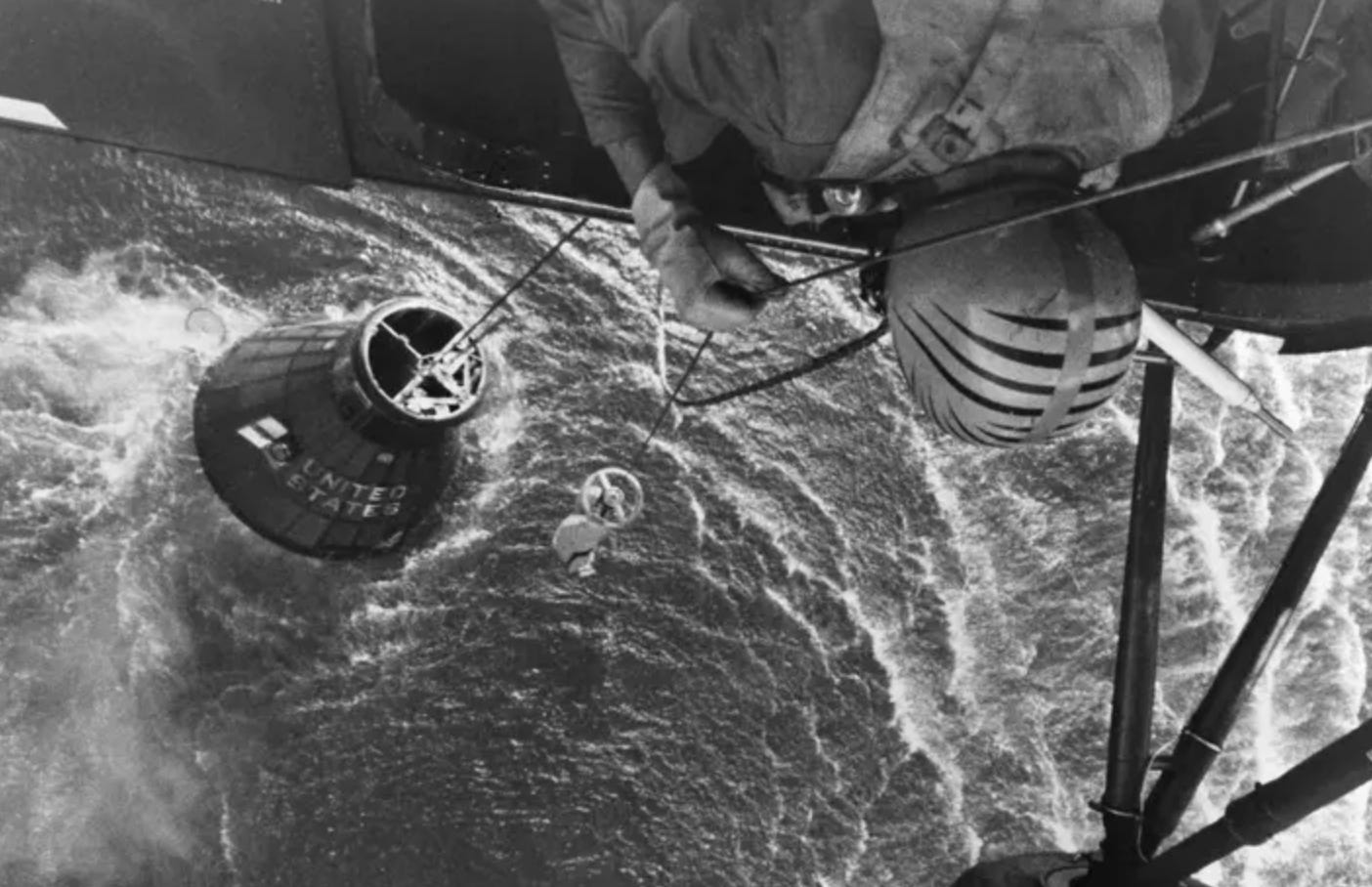
On TV—that great new mass media technology that soared in popularity right alongside NASA’s space race—Americans saw a different story. Viewers tuning into live updates that day were shown video of the Liberty Bell 7 swinging safely and securely from a US Navy helicopter. It was training footage taken days earlier, with no disclaimer.
It took NBC and CBS nearly 10 minutes to correct their mistake after it became clear that the capsule was plummeting to the bottom of the Atlantic.
This historical episode seems so quaint compared to the torrent of competing information streams flooding our present.
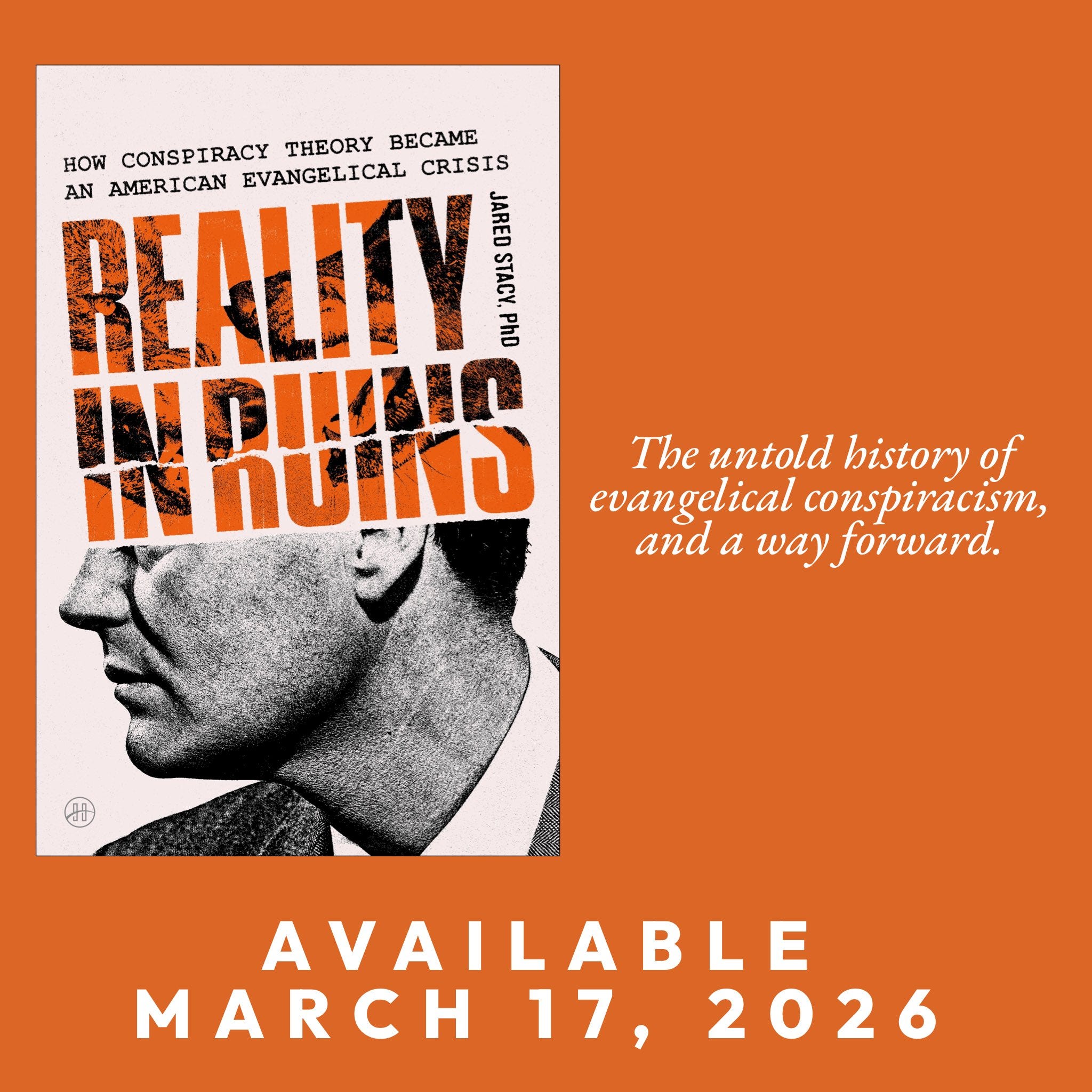
It’s a state of existence I call, “disreality.” In my upcoming book, Reality in Ruins, I unpack Disreality in greater detail. I try to show how the defining question of our time is “what is reality?” We ask this caught in the sludge of AI slop beneath the architecture of surveillance.
Disreality is a technologically induced state of existence where we are caught between competing and clashing realities, created by the seizure and production of information.
And we’re experiencing it all over again: analysis of Renee Good’s death, then—most recently—a new video allegedly showing the late Alex Pretti clashing with ICE agents 11 days before he was shot and killed from behind by an ICE agent.
Immediate reactions ranged from claims the video was AI generated to seizing on it as proof of ICE’s justification in enacting State violence. CNN stated on their Instagram that Pretti’s family confirmed his identity in the latest video. Donald Trump Jr. posted the video on his X account which currently has it at 1.3 million views.
The point I want to make is deeper than the question of whether the video was AI generated. Without discrediting the debate of the video’s authenticity, the question I’m concerned with is how do we live in a time where reality itself is called into question? My point is that Disreality sows a deep distrust in any sort of information or image. We are left with a disquieting nihilism grounded in a sort of permanent, corrosive suspicion. In this time, it is an uncanny experience to hear many who covered for January 6, and the “big lie” of election fraud, now double down on the importance of “the facts.”
But as always, what counts as “the facts” depends on the story being told in the background. But often times, as Bonhoeffer noted, when “truth isn’t trusted, specious propaganda takes over.” Disreality sets ideal conditions for the spread propaganda.
In the mid-20th century, Jacques Ellul warned of the ways propaganda relies on an endless spectacle of images, the kind not just harnessed in Disreality, but created by it.
Ellul understood propaganda in two ways that converge in Disreality.
The first is political. It’s what we most commonly associate with propaganda. Political propaganda refers to “techniques of influence employed by a government, a party, an administration, a pressure group, with a view to change the behaviour of the public.”1 This is why ICE embeds online influencers in its operations.
The second is diffuse, and sociological. Ellul defines it as “the penetration of an ideology by means of its sociological context.” It is political propaganda in reverse. Not top down, but inside, out. Here, the sociality and community, the belonging we experience as “home” does the propagandizing work—the in-group reifies itself against the out group, both ideologically rendered. This sort of propaganda-at-work is ironically displayed in calls by evangelical journalists and influencers to “out” Christian women posting “anti-ICE propaganda.”
In Disreality, this is the norm. It is the experience of the everyday as the expansive architecture of surveillance (another post for another time) slowly engulfs the postwar geo-political structures and institutions we’ve assumed and taken as “given.”
But as a theologian, I’m particularly drawn the question of reality because it is here—right in the ruins, where I believe we recapture what it means to be witnesses to a Story, not merely analysts over raw fact, or even sets of “the facts” that only appear once a certain ideological totality is in place.
Rather than the doubling down of certainty, now is the time for a Christian witness to uncertainty, to the subversive quality of God’s revelation in Christ that sabotages—the choice metaphor from Dutch theologian KH Miskotte.
In my book, I gesture towards the benefits and opportunities of this subversive uncertainty, towards a “good suspicion” for our time. This is not ignorance, but rather epistemic humility and openness that is willing to recognize the invasive and interruptive nature of God’s Word and a faithful response to it, in our time. "
I like how Brian Brock captures it today:
“Many of our contemporaries are discovering that the promise to access, manipulate, and thus gain control over infinite streams of information is marred by the unleashing of a roving ‘want,’ an unrest and concupiscence and disquiet and even sense of entrapment…Idols promise redemption but deliver destruction, Scripture repeatedly warns us, God’s graceful and protective love for us and for our neighbors ultimately being a matter of interrupting our idolatrous designs.”2
As Oscar Romero says, “let us be today’s Christians.” And in a time of disreality and rampant propaganda, I think that involves that path that welcomes the divine sabotage of all we pack up and call “reality” and defend with violence.
For more, consider preordering my book, Reality In Ruins: How Conspiracy Theory Became an Evangelical Crisis
Jacques Ellul, “Political Propaganda and Sociological Propaganda,” in Freedom and Tyranny: Social Problems in a Technological Society, ed. Jack Douglas (New York, NY: Alfred A. Knopf, Inc., 1970). 116-117.
Brian Brock, Joining Creation’s Praise, 896, 906.
This really captures the exhaustion many people feel right now — not just from too much information, but from the sense that reality itself keeps shifting underneath us. I appreciate how you move past simply arguing over facts and instead ask how we live faithfully when certainty itself feels unstable. The idea of “good suspicion” and humility as a Christian posture feels especially needed in a moment where everyone feels pressured to be absolutely sure. I’ve been writing about something related — how love and trust can remain steady even when our sense of certainty doesn’t — if you’d like to read it here: https://theeternalnowmm.substack.com/p/eternal-love?r=71z4jh
Love this and am very much looking forward to your book. I'm also planning to spend a lot of time with Ellul once I am done with grad school and the required reading therein.
This idea of sociological propaganda, I definitely can see how it works and can name some places I can see it at work. It also seems like a natural byproduct of being in community. How do we guard ourselves against "groupthink" while maintaining meaningful community?